Reading an Elevation Profile Before a Touring Day
An elevation profile tells you where a loaded day will actually get hard. Used well, it helps you shorten a stage, reverse a direction, and protect the final climb into lodging before optimism writes a plan your legs cannot hold.
Why distance alone misleads a loaded day
An elevation profile is not decoration for a route screenshot. It is the clearest early signal of whether a planned stage will still feel honest after lunch with bags on the bike. Flat commuting numbers collapse quickly once climbs stack, surfaces change, and wind sits across the same ridge line you hoped to treat as a gentle warm-up stretch.
Before you commit to a corridor, look at where height accumulates, not only at the total. Two stages can share similar mileage and still demand completely different pacing. One may spread climbing across the morning with recovery rolling between pitches. Another may hide a concentrated block of steep grades just when heat and hunger arrive as a pair.
The practical question is simple: can you finish the day with attention left for a bike check, food, and the last approach into lodging. If the profile answers no, rewrite the day before you leave rather than hoping stamina will invent itself on the road later.
How to read climb shape, not just total gain
Start by marking clusters. Circle places where several pitches sit close together with little recovery between them. Those clusters decide fatigue more than a single long climb that has a clear summit and a true descent afterward. Also note false flats: lines that look almost level on a zoomed-out chart but still ask for steady pressure with cargo aboard.
Next, check the timing of the hardest block. A steep sequence early can be managed if you leave with cool air and a full breakfast. The same sequence late often coincides with lower blood sugar, warmer pavement, and a mind already bargaining for shortcuts. Protect the final approach into lodging the way you would protect a deadline: leave a buffer instead of filling every daylight minute on the sheet.
If the last climb sits after a long exposed valley, shorten the stage or reverse the direction. Arriving with reserve is a planning result, not a personality trait you hope to summon.
Also compare the profile against surface notes. A moderate grade on smooth asphalt is different from the same grade on loose gravel. When both steepness and poor surface overlap, treat that segment as a higher-cost block even if the chart looks ordinary on paper.
A working method for the night before
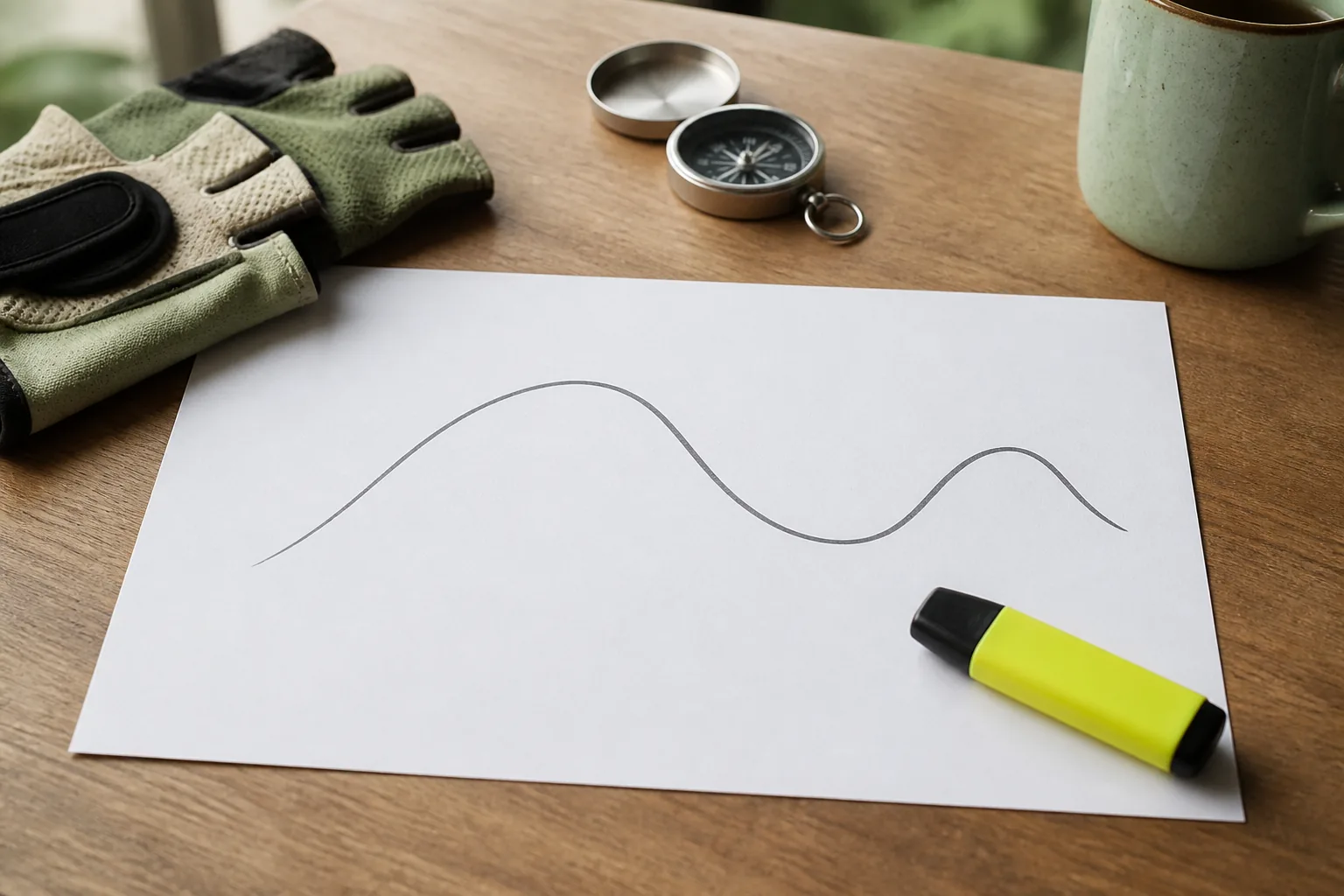
Use a short sequence that forces decisions instead of vague optimism. Print or export the profile, then mark it with three colors or simple labels: sustain, caution, and rewrite. Sustain means the grade fits your loaded pace. Caution means you keep the segment but add time. Rewrite means the day needs a shorter finish, an earlier stop, or a reversed heading.
- Mark every climb that lasts longer than a brief pitch and note whether recovery follows.
- Flag any late-day climb into lodging or food access and give it a time buffer.
- Compare the hardest cluster with wind direction if you already have a forecast trend.
- Decide one concrete change: cut mileage, flip direction, or insert a quieter bailout town.
- Write the revised day sheet with expected effort zones, not only kilometers.
This method keeps the conversation practical. You are not chasing a perfect chart. You are choosing a day that can absorb a slow shop stop, a longer water break, or a surface that rolls worse than the map first suggested.
When reversing direction is the smarter edit
Reversal is underused because people fall in love with the order of towns on a list. Yet direction changes where the hard work sits relative to daylight and services. A climb that faces a common afternoon headwind may become a morning tailwind problem solved simply by flipping the stage. A steep finish into lodging may become a steep start while legs are still fresh.
Before you reverse, check two constraints. First, lodging and transit windows still have to make sense. Second, food access on the new order must remain realistic. If reversal creates a long gap without resupply, it is not free. If it only rearranges effort into a kinder sequence, take that edit.
- Prefer a climb while temperature and attention are higher.
- Avoid finishing into lodging on the steepest pitch of the day when options exist.
- Keep at least one bailout town inside a recoverable distance after the hardest block.
- Confirm that transit or luggage transfers still match the new arrival time.
Translate the profile into a day sheet
A useful day sheet names effort zones rather than pretending every kilometer costs the same. Write a morning block, a middle block, and a finish block. Attach one sentence to each: what could force a slowdown, and what you will cut if that happens. This is where elevation reading becomes rideable instead of a theory on the page.
Include a protected finish. That means the last segment into lodging is short enough that a delayed lunch or a longer repair does not push you into darkness. It also means you know which earlier segment can shrink without destroying the whole plan. Profiles help you choose that shrinkable piece before emotion takes over at the roadside.
What to write beside the chart
Beside the printed profile, note bag weight range, expected rolling surface, and any fixed arrival window. Those three notes stop the common mistake of treating an empty-bike fitness memory as a touring forecast. They also make a consultation faster if you later ask someone else to pressure-test the same stage.
Finally, accept that a good profile reading sometimes reduces ambition. That is not a failed plan. It is the difference between finishing with enough focus to check bolts and tire pressure, and arriving so emptied that small mechanical issues wait until morning when they are harder to repair.
Use the elevation line as a negotiation tool with yourself. Ask where the day can bend, where it cannot, and which climb is allowed to set the tone. When those answers are written down, the road becomes less surprising, and the stage stays under your control even when the wind argues back at you.
Keep revisiting the same profile after short shakedown rides with your actual bags. The chart does not change, but your sense of cost does. That updated sense is what turns a static image into a reliable planning habit for the next corridor on the list.
Common mistakes when first using profiles
The first mistake is trusting a total elevation number without looking at spacing. A day with moderate total gain can still be brutal if the gain arrives in one unbroken sequence. The second mistake is ignoring the relationship between profile and services. A hard block is manageable when a town sits afterward. The same block becomes risky when the next water and food are still a long way off.
The third mistake is treating descents as pure recovery. On loaded bikes, long descents still ask for attention, braking judgment, and sometimes shoulder space. If a descent follows a hard climb into colder wind, your hands and focus may not feel as recovered as the chart implies. Build a little quiet time after major downs before you assume the next pitch will feel easy again.
A fourth mistake is updating the route in the saddle without updating the day sheet. When you skip a town or add a scenic spur, the profile you approved the night before is no longer the plan you are riding. Pause and re-check the remaining climb clusters before you accept the detour as harmless extra.
Keep a simple rule: every meaningful change to the line on the map deserves a second look at the elevation line. That habit turns profile reading from a one-time evening ritual into an ongoing control system for the whole stage you are riding.
Building a reserve into the final hour
The last hour of a touring day is where elevation mistakes become emotional. You can still see lodging on the map, yet the profile still asks for one more pitch. That is when people start skipping food, riding through small mechanical warnings, or accepting a busier road because it looks shorter. A reserve written into the day sheet prevents those roadside bargains.
Reserve can mean different things: an earlier planned stop, a shorter morning segment before the main corridor, or a hard rule that the final climb must begin with enough daylight left. Choose one reserve method and keep it visible on the sheet. Profiles make the need obvious; the reserve makes the need something you can act on.
If the profile shows a late cluster, rehearse the failure version of the day. Ask what you will cut first if the morning runs slow. Ask which town becomes the new finish if weather turns. Writing those answers in calm light is easier than inventing them when the road is already asking for more than you have left.
Over repeated trips, this habit changes how ambitious a day looks on paper. You will still choose strong stages. You will simply stop confusing a dramatic profile with a successful arrival. The aim remains the same: finish with enough clarity to care for the bike and yourself before the next morning begins.